
Hamnet and the Wadlow
Updated: Mar 8
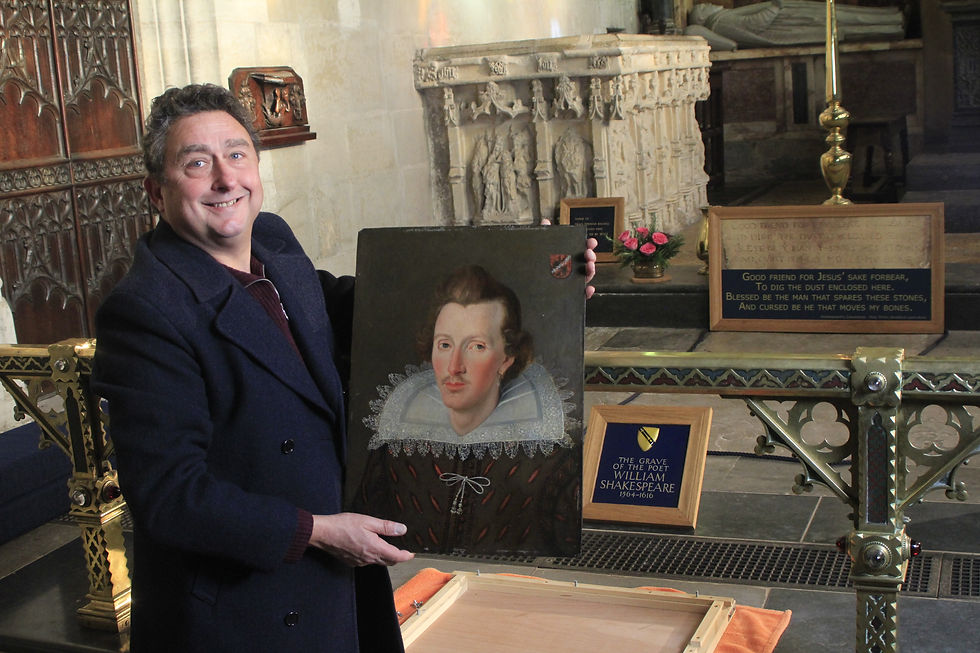
There is a theory supported by experts such as Jean Penicaut of Lumiere Technology, the company that examined the Mona Lisa for the Louvre in Paris, that the Wadlow portrait could have been used on stage as a prop. Jean proposed this theory to explain the overpainting he saw when the portrait was scanned by Lumiere’s LAM system.

In this blog we will look at why the death of Hamnet Shakespeare at the age of 11 makes that theory more likely.
When Peter Wadlow bought the Wadlow portrait he was told it was painted in 1595 and there was a sticker on the back with that date. That date has also been confirmed by expert opinion and scientific tests. However, on hearing this someone recently asked on a web forum why anyone would want a portrait of Shakespeare in 1595.
The question seems to have been based on the assumption that nobody had heard of William Shakespeare in 1595. Aged 31 William Shakespeare was already a well-established playwright in London having already written Romeo and Juliet, A Midsummer Night’s Dream, and Richard II. He was an actor with the Lord Chamberlain’s Men and is listed in records as having been paid for court performances.
1595 also marks the first reference to William Shakespeare as a writer. In his work Polineteia William Covell, mentions “sweet Shakespeare” as a poet. Covell’s book was published only a few years after Venus and Adonis in 1593 and the rape of Lucrece in 1594. It was also the period during which William Shakespeare was reapplying for a coat of Arms, which were granted by the College of Arms in London on October 20, 1596.
Then in 1597 Shakespeare purchased New Place, one of the largest homes in Stratford-upon-Avon, which was to serve as his family home until he died in 1616. So, Shakespeare was clearly on the up in 1595 and had a clear sense of status. What better time to commission a portrait? Other motivations may have been that he was often working in London and his wife could at least have something at home to remind her what he looked like.

Anne Shakespeare nee Hathaway is usually portrayed as the forgotten woman, left behind with the children in Stratford upon Avon whilst William made his name in London. However, in 2025 a fragment of a 17th-century letter was discovered and it was addressed to “Good Mrs Shakspaire”. indicating that she lived in London at Trinity Lane; between 1599 and1603.
The next part of the blog contains spoilers for those who haven’t seen Hamnet. Anne or Agnes Shakespeare as she is called in the film is the main focus of the story. The film imagines what it was like for her living alone in Stratford upon Avon bringing up the three Shakespeare children alone. The pivotal part of the film revolves around the tragic death of Hamnet Shakespeare who probably died of plague aged 11 in 1596. This is something she is left to deal with alone as William is in London when their son dies.

Agnes who is played extremely powerfully by Jessie Buckley then reproaches William on his return after Hamnet’s death with the line “You weren’t there”. The film then goes on to examine how the death of Hamnet affected William Shakespeare and in the final scene Agnes goes to the Globe theatre in London to see a performance of Hamlet in which William is playing the ghost of old King Hamlet. In a highly charged emotional scene Agnes finally recognises how William has channelled his grief over the death of their son through the anguish of his character, Prince Hamlet.
It is a shame that the film didn’t feature the famous closet scene which has been described as the greatest scene in Shakespeare’s greatest play. In the closet scene Hamlet visits his mother Gertrude in her closet/bedroom and then compares a portrait of his father the old king with one of his uncle Clauius who has recently married his mother much to Hamlet’s disliking.
Traditional thinking tells us that the Elizabethan stage didn’t use scenery much less portraits, as the beautiful words were enough to conjure up the required image in the audience’s mind. However, a recent study has questioned this belief. Emanuel Stelzer who is Associate Professor in English literature and the co-chair of the 12th World Shakespeare Congress in Verona describes the Elizabethan stage as a “painted world.”
For his Phd, Emanuel studied the plays of the period and discovered that there are 75 plays between1566 and 1641 that feature portraits on stage. Many of them would have miniatures but some he argues were full sized portraits. In his study he devotes a good deal of time to the closet scene in Hamlet.

Emanuel points out in his study that by 1600 portraits of Shakespeare were already known to exist. The play “Return from Parnassus” features a line that says:
“I’ll worship sweet Mr. Shakespeare, and to honour him will lay his Venus and Adonis under my pillow… and a picture of him in my study…”
Emanuel then enters what he calls the realm of conjecture, “which would include the theory that the theatregoers of some performances of this play could see a portrait of William Shakespeare himself at centre stage.”
There is a very old and well sourced tradition that Shakespeare played the Ghost in Hamlet. It was first mentioned by Nicholas Rowe in his 1709 biography of Shakespeare. When writing this work Rowe was able to speak to old actors who were associated with Shakespeare’s company as his source. Emanuel Stelzer continues by saying that:
“Whole essays have been devoted to… theories of a father mourning his dead son, Hamnet. One biographer has linked the picture in the closet scene to that alluded to in the 1599 university play The Return from Parnassus.
The Parnassus picture of Shakespeare may well be the one in the First Folio that seems to show Shakespeare in his mid- to late thirties, as he was in 1600. Hamlet‘s invitation to his mother: “Look here upon this picture, and on this, The counterfeit presentment of two brothers” may similarly be inspired by a picture of Shakespeare that had been drawn or painted around this time... If Shakespeare played Hamlet‘s father‘s ghost, the subject of one of the two pictures, that would have rendered the lines especially poignant.”
On studying the Wadlow portrait in person as a potential prop, Emanuel, noted the size of the painting and said; “This would work very well”
This raises the question, why would Shakespeare use his prized and costly portrait as a prop? When we spoke to the College of Arms, they suggested that after Hamnet’s death Shakespeare had no male heir to whom he could pass on his family arms. So, maybe the portrait became a reminder of the tragic events surrounding Hamnet’s death. This would explain why he might put the portrait aside only to bring it out again, a few years later, as a prop when he was playing the ghost in Hamlet.

The use of the painting as a prop could also explain the overpainting. When we made our documentary Picturing Shakespeare for PBS, we interviewed Lena Cowen Orlin, who is Professor Emeritus of English at Georgetown University, Washington and author of The Private Life of William Shakespeare. Lena theorised that the use of the portrait as a prop might explain the various layers of overpaint which would have been added as required for whatever play it was used in.
Art Historian Bendor Grosvenor suggested that the visible Coat of Arms on the Wadlow portrait looked continental and Jean Penicaut wondered whether the arms were meant to look like they could be Danish to the audience.

This is all speculation and theory but no more fanciful than the plot of Hamnet which seeks to get inside the mind of Anne and William Shakespeare at a moment of great tragedy in their lives. The film Hamnet finally offers Anne Shakespeare a bit of the limelight and a plausible story, not one based on historically recorded facts, but one which comes up with a realistic reaction to how she dealt with the death of her son when his father was absent in London. The final scene of Hamnet is an incredibly emotional scene in which Anges watches Hamlet on stage and upon seeing the play she finally realises William’s reaction to Hamnet’s death. In the film, William Shakespeare of course expresses his pain through the medium of theatre. Which was the language he knew best.
We are hoping that future research and tests will throw more light on the possibility that the Wadlow portrait might have been used as a prop and who knows we might even discover that it appeared on stage with the bard himself. Now that would be a real Hollywood ending.
If you have any thoughts on this blog scroll to the very bottom of the page to find the comments section.
Madoc and Steven.

Comments