
Wadlow needs your help!
Since starting the research into the Wadlow portrait we believe we have gathered enough evidence to say that there is now a good case that the Wadlow portrait is a lifetime portrait of William Shakespeare. However, that is not enough for the art establishment, so this year we want to fill in some of the gaps in the painting’s provenance and we are asking for your help.
We have several lines of enquiry, the first which involves the father and son firm of picture restorers from whom Peter Wadlow bought the portrait. Guy and Gordon Pryse-Hughes.
N.B. Please note that to leave a comment you need to go right to the bottom of the page.
The Pryse-Hughes
The Pryse-Hughes’ told Peter Wadlow that the place the portrait came from was no ordinary manor house. It was near Banbury, it wasn’t symmetrical with Greek columns, rather, it looked more like a row of houses. The house was being renovated as the owner had money problems.
Following the description Peter gave, Steven researched manor houses within a ten-mile radius of Banbury that fitted his father’s description. There were a few of them that looked promising but the one that was by far the best match for Peter’s description was Great Tew Manor so we are as certain as we can be that, that is the right location. The manor had been inherited by Major Eustace Robb in 1963. Robb was keen to renovate the manor house and the village of Great Tew which had fallen into disrepair but didn’t have the money needed so he was selling items from the manor.

What we would like to find are any eyewitnesses or paperwork that proves that the Pryse-Hughes were working at Great Tew in the late 1960s when Peter bought the painting, or indeed if there is proof that they were working at a different location near Banbury at that time.
What we know about the Pryse Hughes
The Pryse-Hughes had offices in the St James area which was the heart of the art world in London. Major Robb had a London address that was only a few streets away. Originally, the Pryse-Hughes studio was based in Bury Street and then they moved to Dover Street. However, although their studio was in London, they lived in Pinner close to Peter Wadlow. They would often visit Peter at his shop in Harrow and he sometimes did framing work for them. It was as a result of such an arrangement that Peter bought the portrait. He had done a lot of work for them and they owed him a lot of money, so in exchange for £900 Peter took the portrait.
The Wadlow portrait was completely black before it was cleaned. It is oil on panel and Peter was told that it was painted in 1595. When he bought it there was a label on the back giving the date of 1595. He tried to sell it but was told that he had paid too much for it and that the best thing he could do was take it home and hang it on the wall which is what he did. It might seem incredible that a valuable painting could have been in the manor house unknown but when the owner Eustace Robb died a Michelangelo sketch was discovered at Great Tew Manor it was sold at auction for over £4 million.
Watercolours
We also know that along with the portrait Peter also bought several hundred water colours from the same property. After speaking to the husband of the local vicar we know that many watercolours left Great Tew at that time. Peter sold his watercolours through his shop in Harrow. So, if you have a watercolour with a Harrow Arts label on the back please let us know so we can try to trace the provenance and find out where it came from.
Family memories
We were able to trace a branch of the Pryse-Hughes family tree to Tasmania, and they told us that they had visited the studios in 1973. They very kindly sent us photographs of Guy (the father) and Gordon (his son) at work restoring paintings in their studio.

Examining these photographs, we were able to identify the painting that Guy Pryse-Hughes was working on as a portrait of Mary Wilkes or Mrs Hayley by Joshua Reynolds. The portrait remains in the family but unfortunately, they have no recollection of the Pryse-Hughes. So, if you have any information, please let us know.

We would also like to identify the painting that Gordon Pryse-Hughes is working on in the photograph that the family sent us, so we can trace the owners to see if they remember the Pryse-Hughes or if it came from a manor house in the Banbury area. It looks a bit like a Judgement of Solomon by Valeria Castello.

A decade before Peter bought the portraits from the Pryse-Hughes, In the late 1950s Gordon Pryse-Hughes got into financial difficulties and ended up in court facing eight charges including trying to pass off a painting as a Constable. He was found guilty and sent to Wormwood scrubs. Whilst he was there, a Bishop (possibly Robert Stopford the Bishop of London) set Gordon up in a studio at the prison where he spent his time restoring art for the Church.
Other restorations
We also know of several other restorations that the Pryse Hughes did such as the Altar piece by Procaccini in St James church, Whitehaven in the north-west of England and would like to hear from anyone who might have information about this episode.

The family in Tasmania also told us that Gordon was responsible for art restorations at Monkey Island Estate in Bray, Berkshire but couldn’t remember when. It could have been during the 50s ,60s or 70s. We have discovered that Christopher Reynolds bought Monkey Island Hotel from someone called Gibbings in 1963. Then the hotel was sold to Major Fitzwilliams and later to the Weinreb Group, which subsequently went into receivership. In 1976, Paul and Liz Nichols took over the property and turned its fortunes around. There were various periods of restoration during this period. The Hotel is famous for frescoes which include pictures of monkeys. If any of these details or names ring a bell then please get in touch.

The Pryse-Hughes also did restoration work at Kimbolton Castle which became a school in 1949. The chairman of the school board Major Rubem took advice from Oscar Johnson of Legget Brothers, an established Mayfair dealer, who suggested that the school should get their frescoes painted by Pellegrini cleaned. The Pryse Hughes didn’t clean the frescoes themselves, but they did restore the other paintings the school owned.

There is also a photograph of one of the Pryse-Hughes’ with respected St James art dealer Hugh Leggatt next to a Gainsborough portrait of James Lacy. Hugh Leggatt bought the painting for £400 pounds at an auction in London. The Pryse-Hughes cleaned the painting which was then valued £8,000 pounds.
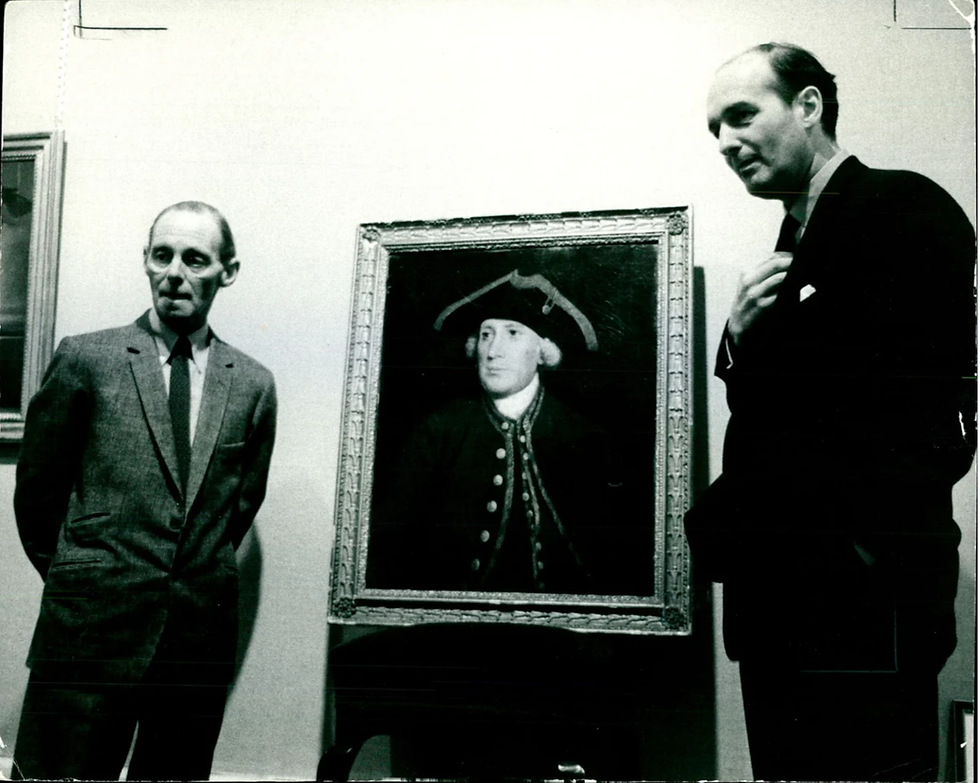
The Pryse-Hughes were at the heart of the art establishment in London and the family told us that they restored a lot of art for private collections throughout England. The Pryse-Hughes relatives said that the type of work done at Great Tew is exactly the sort of work they did.
We are keen to trace as much information about the Pryse-Hughes and their dealings with Peter as we can and would like any information no matter how small. Past experience shows that it is often the smallest piece of information that can unlock important new leads. So. Any help you can offer will be gratefully received.
Please send us an email or leave a comment which you can do at the very bottom of this page.
Steven and Madoc

Comments