
WADLOW, THE CHAPEL AND THE DEVIL
Updated: Oct 28, 2025
The following, is a little bit of fun, with some uncanny revelations!
(I confess it is also an experiment with Chat GPT to see how a collaborative article works.)
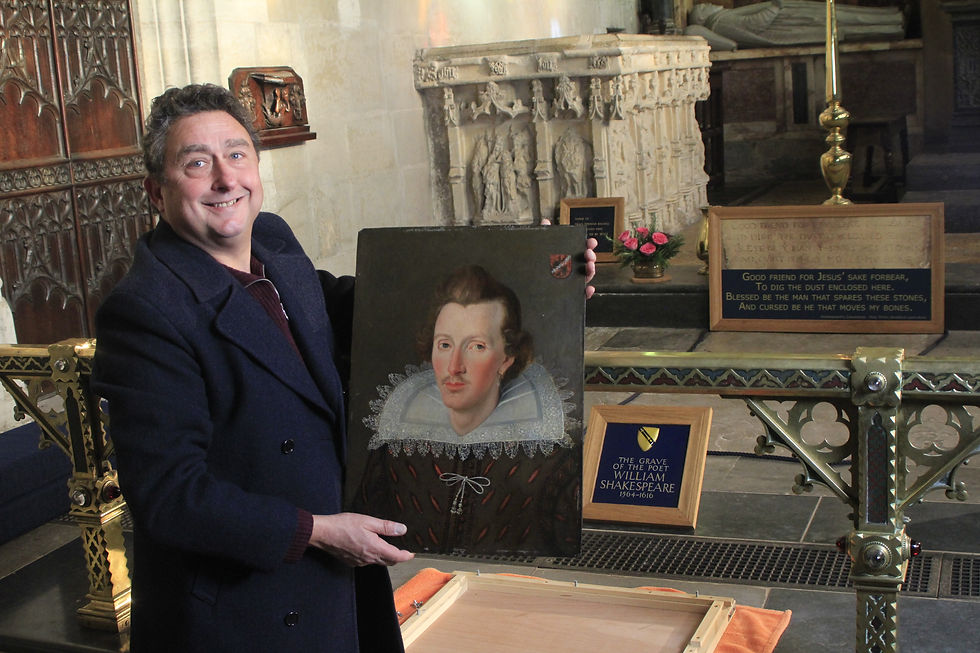
For decades, an unassuming portrait of an Elizabethan gentleman hung quietly in a family home in Tring, Hertfordshire, watching over three generations of the Wadlow family without fanfare or fuss.
Under 70 miles away from where the portrait and the Wadlow’s called home was Stratford-upon-Avon. A lovely town on the river Avon, well worth a visit for its charm alone, but bombarded yearly by visitors from across the Globe wanting to get a feel for the Birth and resting place of the Great William Shakespeare.
Now, that very portrait—backed by dendrochronology, and many other scientific tests and expert analysis that confirm it genuine to the period of Shakespeare and an uncanny resemblance to the First Folio engraving—stands at the centre of a growing debate: could this be a life portrait of William Shakespeare?
Now known as The Wadlow Portrait, it is becoming increasingly debated thanks to "The Stuff of Dreams," a Netflix UK documentary about my quest to find out the truth about whether it could really be Shakespeare, as well as press reports worldwide.
But just for fun, we are going to step away from facts, hypotheses and research for a moment and look at some truly remarkable coincidences. None of which proves anything, but makes you wonder: Is fate playing a hand?
One truly Shakespearean twist of fate, discovered in our research into the life of Shakespeare and his peers, is a tantalising extra character:
Simon Wadlow, a 17th-century London innkeeper who ran the Devil Tavern on Fleet Street, a haunt of none other than Ben Jonson—Shakespeare’s friend, rival, and sometime, probably often, drinking companion.
Is there a link?
We may somewhere along the line be related to the innkeeper, but not so far as we know. It certainly has no relation to provenance or how we modern-day Wadlow’s ended up with Shakey in our home, but the coincidence is so uncanny, so atmospheric, that it begins to feel like a subplot from one of the Bard’s plays.
🍷 Enter “Old Sim, King of Skinkers”
Simon Wadlow wasn’t just any tavern-keeper. He was the licensed vintner of the Devil Tavern, just inside Temple Bar, beginning around 1607. The Devil became a cultural hotspot, frequented by actors, lawyers, poets, and literary luminaries.
Ben Jonson himself presided over a club in the Devil’s Apollo Room and famously penned:
"Hang up all the poor hop-drinkers,
Cries old Sim, the king of skinkers."
A “skinker” was a bartender. Simon Wadlow wasn’t just a man pulling pints; he was running one of the literary nerve centres of Jacobean London.
Jonson even makes a thinly veiled nod to him in The Staple of News (1625), calling it "brave Duke Wadloe’s," and other writers like William Rowley and later Samuel Pepys mention the Devil Tavern as a familiar social hub.
There’s no evidence Shakespeare himself visited the Devil's Tavern, but Shakespeare’s world certainly did, and I hope it's not too far a stretch to imagine he may have known, or known of, Wadlow the Innkeeper.
Then… This Happens
Four hundred or so years later, Peter Wadlow acquired a “Tudor Portrait”, as he called it, after being told it was circa 1595. Hoping for a quick profit, he took it to a London auction house, where he was advised that he had paid too much money for it. “Take a loss or take it home was the further advice. He took it home and hung it in the corner of the sitting room in the small end terrace cottage at the end (and on the corner) of Chapel Street, Tring.
And there it sat for over half a century.
In the Wadlow family home on Chapel Street, Tring, on the corner!
Now let’s pause.
Because Shakespeare’s own house in Stratford, his beloved New Place, sat on the corner of Chapel Street, Stratford-upon-Avon.
In Stratford, Chapel Street is where Shakespeare lived. In Tring, it’s where the Wadlow Portrait sat, quietly gathering dust in the corner of a Wadlow living room. Even today, there is the odd dot of white paint on the portrait, where Peter had painted the ceiling and had not covered it, probably still a little annoyed at how he had paid too much for it!
But Shakespeare, if it is, was happy sitting on the corner of Chapel Street awaiting someone to recognise him, reassured to be in the hands of the Wadlow family, whom he may have once raised the odd glass with.
Mysteries That Refuse to Fade
This is not evidence. No more than Simon Wadlow being a contemporary publican is proof that he poured a pint for the Bard himself. No more than a corner house on Chapel Street is proof of a divine connection.
But it’s uncanny. These threads—the name Wadlow, the tavern, the Apollo Room, the Jonsonian nods, the shared street names—are the kind of details that make even the most hardened sceptic pause and wonder if The Wadlow really is Shakespeare.
They are not claims. They are coincidences, and yet they invite curiosity. They tell us something is in the air.
📜 Shakespeare’s Face – A Debate Still Raging
The Wadlow Portrait doesn’t need folklore to make its case. It already has science, technique, stylistic resonance, and expert interest. The question remains open, although some scholars and documentary filmmakers now think it may be the best candidate for a life portrait we’ve yet seen.
And still, as with all things Shakespeare, certainty remains elusive.
What we do have is a real painting, of real age and quality, held in private hands, not a copy or pastiche, not a fantasy, but an artefact that demands attention.
Add to that the ghost of Simon Wadlow, presiding over poets at the Devil like some Elizabethan Prospero, and the coincidence becomes—well—irresistible. One Hell of a StorySo no, Simon Wadlow didn’t paint the portrait. He didn’t commission it. He’s probably not a lost cousin in a family tree. But his presence—like a flickering stage light in a darkened theatre—illuminates the world in which the Wadlow Portrait could very well have been made.
A world where Shakespeare and Jonson drank in Fleet Street taverns. Where actors, painters, and poets mingled. Where signs showed devils getting their noses tweaked by saints. And where a vintner named Wadlow was crowned “King of Skinkers” by the sharpest wit in London.
If nothing else, it proves this: the name Wadlow belongs to that world.


Comments